Best Corporate LMS (2026): How to Choose the Right Learning Management System
Sophie H
Best Corporate LMS in 2026: How to Choose the Right Learning Management System for Your Organisation
Investing in a corporate Learning Management System (LMS) is no longer simply about moving training online. Organisations today expect learning technology to improve onboarding, reduce administrative workload, strengthen compliance, support professional development and provide leadership with meaningful insight into workforce capability.
Choosing the wrong platform can lead to poor learner engagement, fragmented reporting and increased administration. Choosing the right platform can centralise learning, improve consistency across teams and create a more scalable approach to employee development.
Whether you're replacing spreadsheets, upgrading an ageing LMS or implementing a digital learning strategy for the first time, understanding what makes a modern corporate LMS effective is essential.
If you're looking for a broader introduction to enterprise learning platforms, our Enterprise Learning Management System Guide explores enterprise learning strategy, implementation planning and the role of modern learning technology in greater detail.
What Is a Corporate LMS?
A Corporate Learning Management System (Corporate LMS) is software designed to help organisations deliver, manage and monitor employee learning.
Unlike learning platforms designed primarily for schools or universities, a corporate LMS focuses on workforce development and organisational performance.
Typical use cases include:
- Employee onboarding
- Mandatory compliance training
- Health and safety training
- Cyber security awareness
- Leadership development
- Professional skills development
- Continuing Professional Development (CPD)
- Policy and procedure training
- Certification management
Modern corporate LMS platforms have evolved well beyond simply hosting online courses. Many now incorporate automation, reporting dashboards, competency frameworks and AI-assisted learning experiences.
Why More Organisations Are Investing in Corporate LMS Software
Workplaces have changed significantly over the past decade.
Hybrid working, regulatory requirements, rapid technological change and increasing employee expectations have transformed learning from an occasional HR activity into an ongoing business function.
Organisations are increasingly looking for ways to:
- onboard employees more efficiently
- maintain compliance across multiple sites
- reduce manual administration
- improve employee engagement
- support career development
- provide evidence of completed learning during audits
- deliver consistent training regardless of location
A well-designed corporate LMS helps centralise these activities while giving managers greater visibility into learning progress across the organisation.
The Business Problems a Corporate LMS Solves
Many organisations still rely on disconnected systems to manage learning.
These often include:
- spreadsheets
- shared folders
- email reminders
- PDF documents
- PowerPoint presentations
- manual attendance registers
While these approaches may work initially, they become increasingly difficult to manage as organisations grow.
Common challenges include:
Inconsistent Onboarding
Different managers often deliver different induction experiences.
An LMS allows organisations to create structured onboarding pathways that are ready whenever new employees join.
Limited Compliance Visibility
Without central reporting, organisations may struggle to identify:
- overdue mandatory training
- expired certifications
- departmental compliance levels
- audit evidence
Administrative Burden
Learning teams frequently spend significant time:
- chasing employees
- sending reminder emails
- producing reports
- issuing certificates
Automation can reduce much of this manual work.
Poor Learner Engagement
Static PDFs and slide presentations often fail to maintain learner interest.
Modern platforms increasingly use interactive video, knowledge checks and AI-assisted learning to create more engaging experiences.
What Features Should the Best Corporate LMS Include?
Not every organisation requires the same functionality, but there are several capabilities that consistently provide value across sectors.
1. Structured Learning Pathways
Employees should be able to follow role-specific learning journeys rather than searching for individual courses.
Learning pathways are particularly useful for:
- onboarding
- management development
- compliance programmes
- career progression
2. Compliance Reporting
A corporate LMS should enable managers to quickly answer questions such as:
- Who has completed mandatory training?
- Which certifications are about to expire?
- Which departments require attention?
- Which locations have outstanding compliance requirements?
These reports become particularly valuable during audits and regulatory inspections.
3. AI-Powered Learning Support
Artificial intelligence is becoming an increasingly valuable feature within learning platforms.
Rather than replacing trainers, AI can support learners by:
- explaining difficult concepts
- summarising lessons
- providing practical examples
- reinforcing key learning points
- answering questions about course content
For enterprise deployments, some organisations also choose to configure AI using approved internal policies and procedures, allowing employees to receive guidance that aligns with organisational documentation where appropriate.
4. Mobile Learning
Employees increasingly expect to complete training wherever they work.
A modern LMS should provide a consistent experience across desktop, tablet and mobile devices while allowing learners to continue from where they left off.
5. Executive Reporting
Senior leaders rarely need detailed learner-level data.
Instead, they typically require clear visibility into organisational performance.
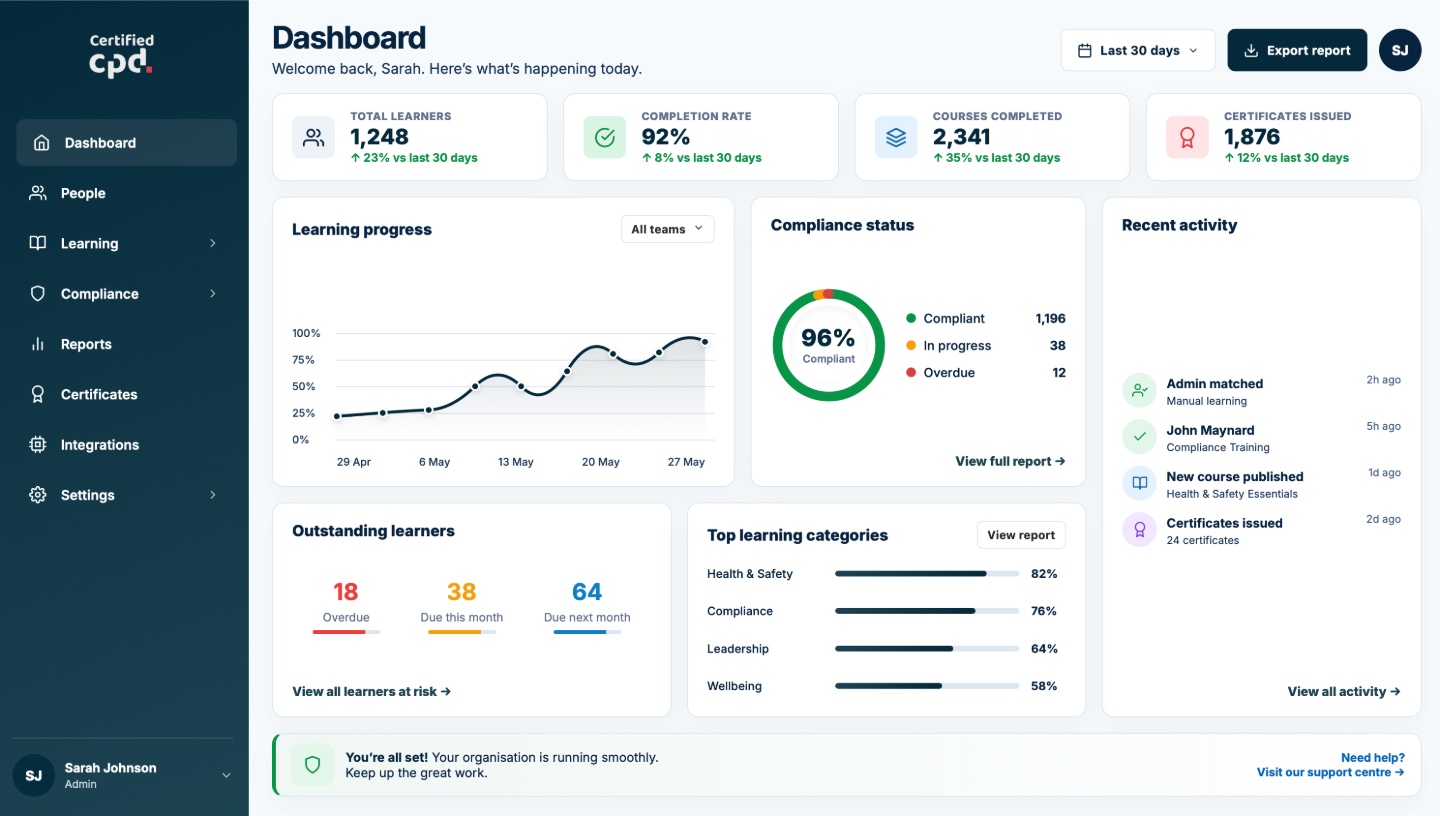
Useful dashboards include:
- overall compliance rates
- onboarding completion
- departmental comparisons
- overdue training
- certification expiry
- learning engagement trends
Corporate LMS vs Traditional Training Management
| Traditional Training | Modern Corporate LMS |
|---|---|
| Paper attendance registers | Digital attendance records |
| Email reminders | Automated notifications |
| Spreadsheets | Live reporting dashboards |
| Classroom-only learning | Blended and online learning |
| Manual certificates | Automatic certification |
| Generic induction | Structured onboarding pathways |
| Difficult audit preparation | Centralised compliance evidence |
How AI Is Changing Corporate Learning
AI is influencing how organisations approach learning, but its role is often misunderstood.
Rather than replacing instructors or subject matter experts, AI can enhance the learner experience by making knowledge more accessible.
Employees can ask questions in plain language, request additional explanations and revisit topics without waiting for scheduled training sessions.
Used appropriately, AI supports continuous learning while allowing trainers to focus on coaching, facilitation and organisational change.
How to Choose the Best Corporate LMS
Before selecting a platform, consider the following questions:
Can it scale as your organisation grows?
Does it support compliance reporting?
Is the learner experience engaging?
Can managers easily monitor progress?
Does it integrate with your existing systems?
Is implementation realistic within your available resources?
Does it support mobile learning?
Can learning pathways be customised for different roles?
What support is available after implementation?
Common Mistakes Organisations Make
Many organisations focus primarily on price.
However, the true cost of an LMS often depends on:
- user adoption
- implementation quality
- reporting capability
- content quality
- administrative efficiency
- long-term scalability
Selecting the cheapest platform may increase administration if it lacks automation or fails to engage learners.
How Certified CPD Supports Corporate Learning
For organisations looking to modernise workplace learning, technology should simplify training rather than create additional administration.
Certified CPD's enterprise learning platform has been designed to help organisations centralise onboarding, compliance training and professional development through interactive learning experiences, executive reporting and AI-assisted learning support. The platform can also be tailored to organisational requirements, including branded deployments and bespoke content where needed.
Frequently Asked Questions
What is the best corporate LMS?
There is no single platform that is best for every organisation. The right solution depends on your size, industry, compliance requirements, integrations, learner experience expectations and budget.
How much does a corporate LMS cost?
Costs vary depending on the number of users, implementation requirements, support services, integrations and whether bespoke content is required.
Can a corporate LMS improve onboarding?
Yes. Many organisations use structured learning pathways to deliver consistent induction programmes, helping new employees complete mandatory learning before or shortly after they begin work.
Can AI improve employee learning?
AI can support learners by explaining concepts, answering questions and reinforcing understanding. It is most effective when used alongside well-designed learning content and subject matter expertise.
Can a corporate LMS help with compliance?
A corporate LMS can assign mandatory learning, monitor completion, issue certificates and provide reporting. Organisations remain responsible for ensuring that their training programmes meet relevant legal, regulatory and organisational requirements.
Final Thoughts
A corporate LMS is no longer simply a platform for hosting online courses. When implemented effectively, it becomes the foundation of an organisation's learning strategy, supporting onboarding, compliance, leadership development and continuous professional growth.
The most successful implementations begin with a clear understanding of organisational objectives rather than a checklist of software features.
If you're still evaluating learning platforms, start by reading our comprehensive Enterprise Learning Management System Guide to understand the wider considerations involved in enterprise learning. When you're ready to explore how a modern AI-enabled learning platform can support your organisation, visit Certified CPD Connect to learn more.