Enterprise Learning Management Systems (2026): The Complete Buyer's Guide to Choosing the Right LMS
Graeme W
Introduction
Learning is no longer something organisations deliver once a year.
Today’s workforce expects continuous development, instant access to knowledge, personalised learning experiences and the flexibility to learn wherever they are. At the same time, employers are under increasing pressure to demonstrate compliance, onboard new employees efficiently, close skills gaps and prepare their workforce for rapidly changing technologies.
These challenges have transformed the role of the enterprise learning management system (LMS) from a simple training portal into one of the most valuable business systems an organisation can invest in.
Modern enterprise learning management software is no longer just about hosting online courses. It enables organisations to manage onboarding, compliance, professional development, leadership programmes and mandatory training through a single intelligent platform. Leaders gain real-time visibility into workforce capability, managers can monitor progress, and employees receive engaging learning experiences that support continuous development.
This is exactly why organisations across healthcare, education, government, energy, construction and corporate sectors are replacing disconnected training systems with integrated learning platforms such as Certified CPD Connect.
Unlike traditional LMS platforms that simply record course completions, modern enterprise platforms combine interactive learning, automated learning pathways, reporting, analytics, digital certification and increasingly, artificial intelligence to improve learning outcomes.
Related: Explore how Certified CPD Connect helps organisations centralise compliance, onboarding and professional development within a single enterprise learning platform.
The workplace has changed dramatically over the last decade.
Hybrid working has become commonplace. Employees expect mobile-first learning experiences. Compliance requirements continue to evolve, while organisations must constantly upskill their workforce to remain competitive.
Unfortunately, many organisations still rely on outdated approaches to training.
Learning records are spread across spreadsheets.
Mandatory training is managed manually.
Managers struggle to identify overdue compliance.
New starters receive inconsistent onboarding experiences.
Training becomes a one-off event rather than an ongoing process.
The result is increased administrative effort, reduced learner engagement and limited visibility into organisational capability.
An enterprise LMS addresses these challenges by bringing learning into one central environment where every employee has access to the right learning at the right time.
Whether you’re delivering induction programmes, mandatory compliance, leadership development, cyber security awareness or continuing professional development (CPD), the right platform provides consistency, scalability and measurable results.
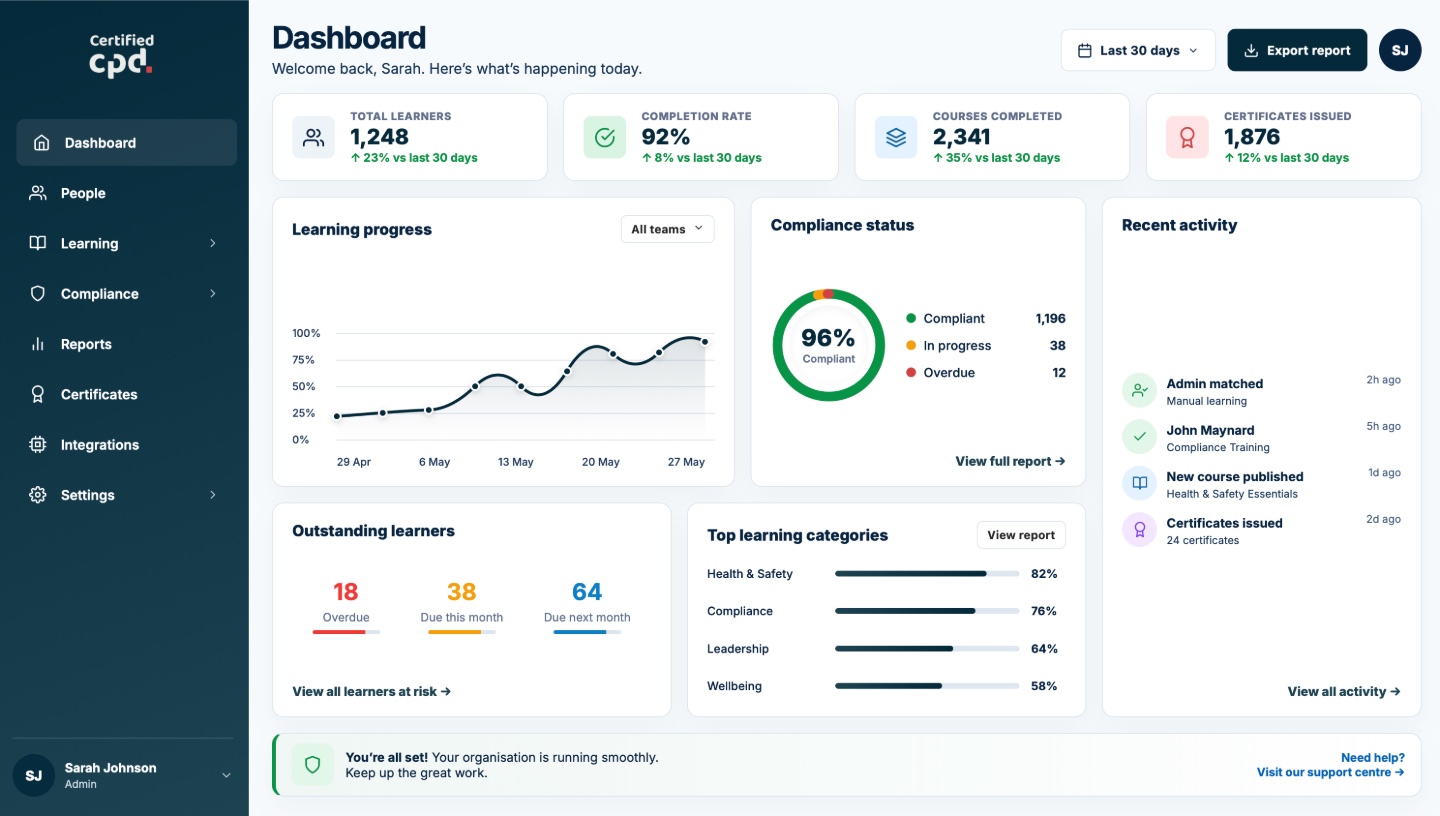
For organisations looking to build structured onboarding and compliance programmes, a dedicated platform such as Certified CPD Connect also enables administrators to automate enrolment, monitor learner progress and produce audit-ready reports from a single dashboard.
What You’ll Learn in This Guide
Choosing a corporate LMS is a significant investment, and comparing vendors can quickly become overwhelming.
This guide has been written to help HR leaders, Learning & Development professionals, compliance managers, operations teams and organisational leaders understand what really matters when selecting an enterprise learning management system.
Throughout this guide you’ll discover:
· What an enterprise learning management system is.
· How enterprise LMS platforms differ from traditional training systems.
· The essential features every modern LMS should include.
· How artificial intelligence is reshaping workplace learning.
· How to compare enterprise learning management software.
· Common mistakes organisations make when purchasing an LMS.
· Practical advice for successful implementation and long-term adoption.
We’ll also explore how organisations are using enterprise learning platforms to improve onboarding, reduce compliance risk, increase learner engagement and create a culture of continuous learning.
Chapter 1 – What Is an Enterprise Learning Management System?
An enterprise learning management system (LMS) is a software platform designed to create, deliver, manage and monitor learning across an organisation.
Unlike consumer learning platforms that focus on individual learners, enterprise LMS software is built to support the operational, compliance and workforce development needs of businesses, educational institutions, healthcare providers and public sector organisations.
At its core, an enterprise LMS provides one central location where organisations can manage every aspect of employee learning.
This includes:
· Employee onboarding
· Mandatory compliance training
· Continuing Professional Development (CPD)
· Leadership development
· Technical training
· Health & Safety programmes
· Cyber security awareness
· Policy training
· Professional certifications
Instead of managing these activities across multiple systems, spreadsheets and manual processes, organisations can centralise learning through a single enterprise learning platform.
For example, organisations using Certified CPD Connect can combine accredited online learning, role-based learning pathways, reporting dashboards, assessments and digital certificates within one branded learning environment.
An Enterprise LMS Is Much More Than Online Courses
Many people assume a learning management system simply stores videos or PDF documents.
That may have been true fifteen years ago.
Modern enterprise learning management software has evolved into a comprehensive workforce development platform capable of supporting learning throughout an employee’s entire career.
Today’s leading LMS platforms typically include:
· Interactive multimedia learning
· Learning pathways
· Role-based enrolment
· AI-powered learning support
· Digital assessments
· Online examinations
· Manager dashboards
· Compliance reporting
· Automated certificates
· Skills tracking
· Mobile learning
· Single Sign-On (SSO)
· API integrations
· White-labelled learning portals
· Multi-organisation management
These capabilities allow organisations to move beyond simply recording course completions and instead build structured learning journeys aligned to business objectives.
For organisations delivering mandatory compliance or accredited professional development, integrating these features into one platform significantly reduces administration while improving learner engagement.
You can see an example of this approach in Certified CPD Connect, where organisations combine interactive courses, AI-assisted learning, reporting and compliance management within a single platform.
Why the Word “Enterprise” Matters
Not every LMS is designed for enterprise use.
A small business delivering occasional staff training has very different requirements from a multinational organisation managing thousands of learners across multiple countries.
Enterprise learning management software must support:
· Large numbers of users
· Multiple business units
· Department-based learning pathways
· Advanced permissions
· Multi-language delivery
· Detailed audit reporting
· Compliance monitoring
· HR system integration
· Identity management and Single Sign-On
· API connectivity
· Enterprise-grade security
· Scalability as organisations grow
These capabilities ensure the platform supports not only today’s training requirements but also future organisational growth.
In the next chapter, we’ll explore why organisations across every industry are investing in enterprise learning management systems, the business problems they solve and the measurable return on investment they can deliver.
Chapter 2 – Why Organisations Need an Enterprise Learning Management System
For many organisations, learning and development has evolved from a support function into a strategic business priority. Regulatory requirements are increasing, employee expectations are changing, and organisations are under constant pressure to develop new skills while maintaining productivity.
An enterprise learning management system (LMS) provides the infrastructure needed to meet these challenges at scale.
The question is no longer “Should we have an LMS?”
The better question is:
Can your organisation afford to manage workforce learning without one?
The Hidden Cost of Traditional Training
Many organisations still rely on a mixture of classroom sessions, spreadsheets, shared drives, email reminders and paper attendance registers to manage learning.
While this approach may appear inexpensive initially, the hidden costs quickly accumulate.
Common challenges include:
· HR teams manually assigning training.
· Managers chasing overdue learners.
· Multiple versions of policies being circulated.
· Limited visibility of compliance.
· Inconsistent onboarding between departments.
· Duplicate training records.
· Employees forgetting what they learned shortly after completing a course.
Every manual process consumes valuable administrative time that could otherwise be spent developing people rather than managing paperwork.
An enterprise learning management system automates these repetitive tasks, enabling learning teams to focus on improving capability rather than administration.
For example, organisations using Certified CPD Connect can automatically enrol learners into role-based learning pathways, issue digital certificates, generate compliance reports and monitor organisational progress from a single dashboard.
Solving the Five Biggest Workforce Learning Challenges
1. Faster Employee Onboarding
First impressions matter.
Research consistently shows that structured onboarding improves employee engagement, confidence and retention. Yet many organisations still deliver induction using inconsistent documents, presentations and face-to-face sessions.
An enterprise LMS standardises onboarding by ensuring every new employee receives the same high-quality learning experience.
Typical onboarding pathways include:
· Company introduction
· Organisational values
· Health and Safety
· Cyber Security Awareness
· Data Protection
· Equality and Diversity
· Role-specific training
· Manager induction
· Policy acknowledgement
Instead of waiting for scheduled classroom sessions, employees begin learning immediately.
Progress is tracked automatically while managers receive real-time visibility into completion.
Related: Discover how Certified CPD Connect creates structured onboarding pathways that automatically assign learning based on job role and department.
2. Simplifying Compliance Management
Compliance is one of the primary reasons organisations invest in enterprise learning management software.
Whether you’re operating within healthcare, education, construction, finance or manufacturing, demonstrating employee competence is essential.
Without a central platform, compliance quickly becomes difficult to manage.
Questions such as these become difficult to answer:
· Who has completed mandatory training?
· Which certificates are about to expire?
· Which departments have overdue learning?
· Are temporary staff compliant?
· Can evidence be produced during an audit?
An enterprise LMS provides complete visibility through automated reporting and real-time dashboards.
Administrators can instantly identify compliance gaps before they become organisational risks.
Employees receive automatic reminders before certifications expire, reducing the likelihood of missed mandatory training.
3. Developing Skills Continuously
Modern organisations compete on knowledge.
Employees no longer remain in static roles throughout their careers.
New technologies emerge rapidly.
Industries evolve.
Regulations change.
Continuous learning has become essential.
Rather than delivering isolated training events, enterprise LMS platforms enable organisations to create personalised learning pathways that support long-term professional development.
Employees can progress from foundational knowledge through advanced leadership programmes while managers monitor progress against organisational objectives.
This transforms learning from an annual exercise into an ongoing culture of development.
4. Providing Meaningful Learning Data
One of the biggest advantages of an enterprise LMS is visibility.
Traditional training often answers only one question:
“Did someone attend?”
Modern learning platforms answer much more valuable questions:
· Who completed training?
· How engaged were learners?
· Which departments require support?
· Which courses have the highest completion rates?
· Which learning pathways produce the best outcomes?
· Where are organisational skills gaps emerging?
These insights enable leaders to make evidence-based decisions rather than relying on assumptions.
Interactive reporting dashboards also reduce the administrative burden placed on HR and Learning & Development teams.
Organisations using Certified CPD Connect can generate real-time reports across departments, locations and learning pathways, providing leadership with a live picture of workforce capability.
5. Improving Learner Engagement
One of the most common criticisms of workplace learning is that employees complete training simply to “tick a box.”
Long presentations, static slides and repetitive assessments often result in poor knowledge retention.
Modern enterprise LMS platforms focus on learner engagement.
Features such as:
· Interactive video
· Scenario-based learning
· Knowledge checks
· Mobile access
· Learning pathways
· Gamification
· Digital certificates
· AI-assisted learning support
help transform learning into an engaging experience rather than an administrative obligation.
Employees are more likely to complete training, retain knowledge and apply learning in their daily work.
The Business Benefits of Enterprise Learning Management Software
When implemented effectively, an enterprise LMS delivers measurable organisational benefits.
Improved Compliance
Automated assignment, reminders and reporting reduce the risk of overdue mandatory training.
Reduced Administration
Automation significantly decreases manual workload for HR and Learning teams.
Faster Onboarding
New employees become productive sooner through structured learning pathways.
Better Decision Making
Real-time analytics provide leaders with actionable workforce insights.
Higher Engagement
Interactive learning experiences encourage greater participation.
Organisational Consistency
Every learner receives the same high-quality learning regardless of location.
Scalable Workforce Development
Training programmes can be delivered consistently across hundreds or thousands of employees.
Enterprise Learning Is Becoming a Competitive Advantage
Historically, organisations viewed learning as a cost.
Today, organisations increasingly recognise learning as a competitive advantage.
Businesses that continuously develop their workforce adapt more quickly to change, attract stronger talent and build greater organisational resilience.
The role of an enterprise learning management system is therefore much broader than delivering online courses.
It becomes the platform through which organisations develop people, reduce organisational risk and support long-term growth.
Chapter 3 – Essential Features Every Enterprise Learning Management System Should Include
Not every LMS offers the same capabilities.
Some platforms focus primarily on hosting courses.
Others specialise in compliance.
Some provide excellent reporting but poor learner experiences.
Choosing the right enterprise learning management software requires understanding which features genuinely contribute to organisational success.
Below are the capabilities every modern enterprise LMS should provide.
1. Centralised Learning Management
Every employee should access learning through one secure platform.
This eliminates duplicate systems while providing a consistent user experience.
The platform should support:
· Online learning
· Instructor-led training
· Blended learning
· Assessments
· Learning resources
· Certificates
2. Role-Based Learning Pathways
Different employees require different learning.
Managers need leadership development.
IT teams require cyber security training.
New starters complete induction.
Compliance officers complete regulatory learning.
Role-based pathways automatically assign appropriate learning based on job role, department or location.
This reduces administration while ensuring consistency.
Certified CPD Connect enables organisations to build customised learning pathways aligned with organisational policies and competency frameworks.
👉 https://www.certifiedcpd.com/connect
3. Interactive Learning Experiences
Employees learn more effectively when content is engaging.
Look for platforms supporting:
· Interactive video
· Knowledge checks
· Scenarios
· Simulations
· Multimedia
· Practical activities
Avoid systems that rely solely on static slide presentations.
4. Artificial Intelligence
Artificial Intelligence is rapidly becoming one of the most important developments in enterprise learning.
Rather than replacing trainers, AI enhances learning by providing personalised support throughout the learning experience.
Modern AI features include:
· Explaining complex concepts
· Answering learner questions
· Providing real-world examples
· Summarising content
· Reinforcing understanding
· Personalising explanations
Some enterprise platforms—including Certified CPD Connect—also allow AI assistants to reference an organisation’s own policies and procedures, giving learners contextual guidance alongside course content.
This dramatically improves knowledge retention while reducing the volume of support requests received by HR and Learning teams.
5. Reporting and Analytics
Executives require more than completion reports.
Modern LMS dashboards should provide:
· Compliance status
· Department performance
· Learner engagement
· Skills progress
· Assessment outcomes
· Certification tracking
· Expiring qualifications
Interactive dashboards help leaders identify organisational risks before they become operational issues.
6. Compliance Management
Compliance functionality should include:
· Mandatory learning
· Automatic reminders
· Recurring training
· Audit reporting
· Digital evidence
· Certificate management
These features are particularly valuable for regulated industries including healthcare, education, construction and financial services.
7. Mobile Learning
Employees increasingly expect to learn wherever they are.
A modern corporate LMS should work seamlessly across:
· Desktop
· Tablet
· Mobile devices
Responsive design enables learning to continue whether employees are working remotely, travelling or on-site.
8. Integration Capabilities
Enterprise software rarely operates in isolation.
An LMS should integrate with:
· HR Information Systems (HRIS)
· Microsoft Entra ID / Azure AD
· Google Workspace
· Single Sign-On (SSO)
· Microsoft Teams
· CRM systems
· Business intelligence tools
· APIs
· SCORM and xAPI content
Strong integrations reduce duplicate administration while improving the user experience.
9. White Labelling
Many organisations want learning environments that reflect their own identity.
White-labelled platforms allow organisations to customise:
· Logo
· Colours
· Domain
· Certificates
· Email notifications
· Learning portal
This strengthens employee engagement and creates a seamless organisational experience.
10. Scalability
Finally, enterprise learning management software must grow with the organisation.
The platform should comfortably support:
· Thousands of learners
· Multiple organisations
· Multiple countries
· Multiple languages
· Future integrations
· Expanding course libraries
Choosing a scalable platform avoids expensive migrations as organisational needs evolve.
Choosing Features That Deliver Business Value
It’s easy to become distracted by lengthy feature lists during LMS evaluations.
The most successful organisations focus instead on outcomes.
Ask:
· Will this reduce administration?
· Will learners engage with the content?
· Can leadership measure workforce capability?
· Will compliance become easier to manage?
· Will the platform still meet our needs in five years?
Technology should simplify learning—not make it more complicated.
In the next chapter, we’ll explore one of the fastest-growing areas of enterprise learning: how Artificial Intelligence is transforming learning management systems and changing the way employees learn at work.
Chapter 4 – How Artificial Intelligence Is Transforming Enterprise Learning Management Systems
Artificial Intelligence (AI) is rapidly becoming one of the most significant advancements in workplace learning. While the first generation of learning management systems focused on storing courses and tracking completions, today’s enterprise platforms are evolving into intelligent learning environments that actively support learners throughout their development.
This shift is changing how organisations think about learning.
Instead of asking, “Has the employee completed the course?”, organisations are now asking:
· Did the employee understand the content?
· Can they apply what they’ve learned?
· Where are they struggling?
· What learning should they complete next?
· How can we personalise development for every employee?
AI enables organisations to answer these questions in ways that were previously impossible.
From Content Delivery to Learning Support
Traditional eLearning often follows a simple pattern.
Employees log in.
They watch a presentation.
Click through several slides.
Complete a short assessment.
Receive a certificate.
Unfortunately, this process doesn’t necessarily mean learning has taken place.
Many employees complete mandatory training because they have to—not because they’re engaged.
Knowledge is often forgotten within days.
Employees who don’t understand a topic frequently leave the course without asking questions, either because support isn’t available or because they don’t know who to ask.
Artificial Intelligence changes this experience completely.
Rather than acting as passive content, modern enterprise learning platforms can become active learning partners.
Imagine a learner completing a cyber security awareness course.
Instead of simply reading about phishing attacks, they can ask:
“Can you explain phishing using a real workplace example?”
The AI responds immediately.
If they remain unsure, they can ask:
“Explain this as if I have no technical background.”
The explanation changes accordingly.
This creates an experience that is significantly closer to one-to-one coaching than traditional online learning.
AI Is Personalising Enterprise Learning
One of the greatest challenges organisations face is that every employee learns differently.
Some prefer detailed explanations.
Others learn visually.
Some require practical examples.
Others benefit from summarised content before moving into deeper learning.
Traditional LMS platforms deliver exactly the same experience to everyone.
Artificial Intelligence enables learning to adapt to individual learners.
AI can:
· Explain difficult concepts differently.
· Provide practical workplace examples.
· Generate summaries.
· Reinforce key learning points.
· Recommend additional learning.
· Answer follow-up questions.
· Help learners prepare for assessments.
· Encourage reflection after completing training.
This significantly improves knowledge retention while reducing learner frustration.
AI Should Support Trainers—Not Replace Them
A common misconception is that Artificial Intelligence replaces trainers or subject matter experts.
In reality, the opposite is true.
High-quality learning still begins with experienced instructional designers, industry specialists and educators who develop structured, accurate learning content.
AI enhances that learning.
It helps employees understand content more effectively, but it doesn’t replace expertise, professional judgement or organisational context.
Think of AI as providing every learner with an intelligent study partner that’s available 24 hours a day.
Enterprise AI Goes Beyond Public Chatbots
Many organisations are understandably cautious about AI.
Questions often include:
· Is our information secure?
· Can employees trust AI responses?
· Will confidential information be exposed?
Modern enterprise learning platforms address these concerns through controlled implementations.
Rather than allowing unrestricted access to public AI models, organisations can deploy AI within defined boundaries.
For example, Certified CPD Connect integrates AI directly into learning experiences. Learners can ask questions about course content, receive contextual explanations and reinforce their understanding without leaving the platform.
For enterprise customers, AI can also be configured to reference approved organisational documentation, allowing employees to ask questions about internal policies and procedures alongside their learning content. This helps reduce confusion while ensuring staff receive guidance based on approved organisational information.
AI Improves Compliance Learning
Compliance training has traditionally suffered from low engagement.
Employees often complete mandatory learning because they are required to do so rather than because they find it valuable.
Artificial Intelligence changes this dynamic.
Instead of simply presenting legislation or organisational policies, AI enables learners to ask:
· “What does this mean in my role?”
· “Can you give me an NHS example?”
· “How would this apply in a school?”
· “Can you explain this using a construction site scenario?”
Learning becomes immediately relevant.
This contextual approach improves understanding and helps employees apply compliance requirements in real workplace situations rather than simply recalling information during an assessment.
For organisations delivering mandatory compliance training through Certified CPD Connect, AI helps reinforce understanding while complementing interactive learning, assessments and reporting.
AI and Learning Analytics
Artificial Intelligence also provides valuable insights for organisations.
Instead of simply tracking completions, AI can help identify:
· Frequently misunderstood topics.
· Courses generating the most learner questions.
· Skills requiring reinforcement.
· Departments needing additional support.
· Emerging knowledge gaps.
These insights enable Learning & Development teams to continuously improve learning programmes rather than relying solely on completion statistics.
Learning becomes an evolving process driven by evidence rather than assumptions.
The Future of Enterprise Learning
Artificial Intelligence is unlikely to replace learning management systems.
Instead, it is transforming what organisations expect from them.
Tomorrow’s enterprise LMS platforms will increasingly become intelligent workforce development systems capable of guiding learners, identifying skills gaps and supporting continuous professional development throughout an employee’s career.
Organisations investing today should therefore evaluate not only current functionality but also the platform’s long-term AI strategy.
As workforce expectations continue to evolve, AI-enabled learning is likely to become a standard capability rather than a competitive advantage.
Chapter 5 – Enterprise Learning Management Systems vs Traditional Training
Most organisations still combine several approaches to learning.
Classroom workshops.
Face-to-face inductions.
Paper attendance sheets.
PowerPoint presentations.
Email reminders.
Shared folders.
Online courses.
Each of these methods has value.
However, relying solely on traditional training methods creates significant operational challenges as organisations grow.
An enterprise learning management system provides a scalable alternative that complements instructor-led learning while improving consistency, reporting and accessibility.
The question isn’t whether classroom learning should disappear.
It’s how organisations can combine the strengths of traditional learning with the flexibility and intelligence of digital learning.
Traditional Training Has Important Strengths
Face-to-face learning remains valuable for:
· Leadership workshops.
· Practical demonstrations.
· Team discussions.
· Coaching.
· Hands-on assessments.
· Collaborative problem-solving.
Experienced trainers provide immediate feedback while encouraging discussion and interaction.
For complex or practical subjects, classroom learning continues to play an important role.
However, traditional delivery also introduces several operational limitations.
The Challenges of Traditional Training
As organisations grow, classroom-based learning becomes increasingly difficult to manage.
Training must be scheduled.
Meeting rooms booked.
Trainers allocated.
Employees removed from operational duties.
Attendance manually recorded.
Certificates produced.
Records updated.
Managers informed.
This process becomes increasingly expensive and time-consuming.
Even after significant investment, organisations often struggle to answer basic questions:
· Has everyone completed the training?
· Who still requires certification?
· Which locations remain non-compliant?
· When does refresher training become due?
Without a central system, these questions often require manual investigation.
How Enterprise Learning Management Systems Solve These Challenges
Enterprise LMS platforms centralise every aspect of organisational learning.
Employees access learning whenever they need it.
Managers monitor progress through live dashboards.
Administrators automate enrolment and certification.
Leadership teams gain visibility into organisational capability.
Instead of replacing classroom learning, the LMS supports it.
Instructor-led workshops can still take place while attendance, assessments, learning materials and certificates are managed digitally.
This creates a blended learning approach that combines the strengths of both methods.
Traditional Training vs Enterprise LMS
Traditional Training
Enterprise Learning Management System
Fixed schedules
Learn anytime, anywhere
Paper attendance
Digital tracking
Manual reminders
Automated notifications
Classroom only
Classroom, online and blended learning
Difficult reporting
Real-time dashboards
Manual certificates
Automatic digital certification
One-size-fits-all delivery
Personalised learning pathways
Limited visibility
Organisation-wide analytics
Inconsistent onboarding
Standardised induction programmes
Reactive compliance
Proactive compliance monitoring
Traditional Training | Enterprise Learning Management System |
Fixed schedules | Learn anytime, anywhere |
Paper attendance | Digital tracking |
Manual reminders | Automated notifications |
Classroom only | Classroom, online and blended learning |
Difficult reporting | Real-time dashboards |
Manual certificates | Automatic digital certification |
One-size-fits-all delivery | Personalised learning pathways |
Limited visibility | Organisation-wide analytics |
Inconsistent onboarding | Standardised induction programmes |
Reactive compliance | Proactive compliance monitoring |
Supporting Hybrid and Remote Workforces
The workplace has changed significantly.
Employees now work:
· Remotely.
· Across multiple sites.
· Internationally.
· In hybrid environments.
· Across different time zones.
Traditional classroom delivery struggles to accommodate these working patterns.
Enterprise learning management software provides consistent access regardless of location.
Employees can complete learning on desktop, tablet or mobile devices whenever it suits operational requirements.
Managers maintain visibility without needing employees to be physically present.
This flexibility is particularly valuable for organisations operating across multiple offices or countries.
Learning Should Continue Beyond the Training Session
One limitation of traditional learning is that knowledge often disappears once the session ends.
Employees return to work and gradually forget key concepts.
With an enterprise LMS, learning continues long after the course has finished.
Employees can:
· Revisit learning materials.
· Download supporting resources.
· Review assessments.
· Access updated policies.
· Complete refresher training.
· Continue structured development through learning pathways.
Learning becomes an ongoing process rather than a single event.
Measuring Return on Investment
Perhaps the greatest difference between traditional learning and an enterprise LMS is visibility.
Traditional learning measures attendance.
Enterprise learning platforms measure outcomes.
Organisations can monitor:
· Completion rates.
· Assessment performance.
· Departmental compliance.
· Learning engagement.
· Certification status.
· Skills development.
· Organisational capability.
These insights help leaders understand whether learning is contributing to business objectives rather than simply recording participation.
Through platforms such as Certified CPD Connect, organisations can combine interactive learning, compliance management, reporting, AI-assisted support and structured learning pathways within a single enterprise platform, enabling workforce development to become a measurable business function rather than an administrative exercise.
Enterprise Learning Is No Longer Optional
As organisations continue to grow, managing learning manually becomes increasingly unsustainable.
An enterprise LMS doesn’t eliminate classroom learning—it strengthens it.
By combining digital learning, instructor-led programmes, AI-assisted support, analytics and automation, organisations create a scalable learning ecosystem capable of supporting both today’s workforce and tomorrow’s skills requirements.
In the next chapter, we’ll explore how to evaluate enterprise learning management systems, compare vendors objectively and choose a platform that aligns with your organisation’s long-term goals rather than simply its immediate training needs.
Chapter 6 – How to Choose the Right Enterprise Learning Management System
Selecting an enterprise learning management system (LMS) is a strategic decision that can influence employee development, compliance, productivity and organisational performance for many years.
Unfortunately, many organisations choose an LMS based primarily on demonstrations, feature lists or price comparisons.
While these factors are important, they rarely determine long-term success.
The best enterprise learning management software isn’t necessarily the platform with the most features—it’s the platform that aligns with your organisation’s objectives, integrates with existing systems and delivers an engaging learning experience that employees actually use.
Before evaluating vendors, organisations should first understand their own learning requirements.
Step 1: Define Your Business Objectives
Every successful LMS implementation begins with a clear understanding of why the organisation is investing in a platform.
Ask questions such as:
· Are we trying to improve onboarding?
· Do we need better compliance reporting?
· Are we replacing an existing LMS?
· Do we need to support multiple countries?
· Are we developing leadership capability?
· Do we want to reduce administrative workload?
· Are we introducing AI into workplace learning?
Without clear objectives, it’s easy to become distracted by impressive demonstrations that don’t solve the organisation’s actual challenges.
For many organisations, the goals extend beyond simply delivering online courses. They include improving operational efficiency, reducing compliance risk, accelerating employee development and creating a culture of continuous learning.
Step 2: Evaluate the Learner Experience
One of the biggest reasons LMS projects fail is poor adoption.
Employees won’t engage with a platform that is difficult to navigate or provides a frustrating learning experience.
During demonstrations, evaluate the system from the learner’s perspective.
Consider:
· Is the interface intuitive?
· Can learners find courses easily?
· Does it work well on mobile devices?
· Can employees resume learning where they left off?
· Is the platform accessible for users with different needs?
· Is the content engaging?
Remember, the LMS isn’t built for administrators alone.
Its success depends on employee engagement.
Platforms like Certified CPD Connect prioritise learner experience through interactive course design, structured learning pathways, mobile accessibility and AI-assisted learning support that helps employees understand complex topics rather than simply complete mandatory training.
Step 3: Assess Reporting and Analytics
Learning data should support better business decisions.
An enterprise LMS should provide more than completion reports.
Ask vendors to demonstrate:
· Organisation-wide dashboards.
· Department reporting.
· Compliance status.
· Learner engagement.
· Assessment performance.
· Skills tracking.
· Certificate management.
· Audit reporting.
· Export capabilities.
Senior leaders should be able to understand workforce capability without requesting manual reports from HR or Learning & Development teams.
If reporting requires significant manual effort, the platform is unlikely to deliver long-term value.
Step 4: Review Integration Capabilities
Your LMS should integrate seamlessly into your existing technology ecosystem.
Key integrations include:
· HR Information Systems (HRIS)
· Microsoft Entra ID / Azure AD
· Google Workspace
· Microsoft Teams
· Single Sign-On (SSO)
· CRM platforms
· Payroll systems
· SCORM and xAPI content
· APIs for future integrations
Strong integration reduces duplication, improves data accuracy and simplifies user management.
If your organisation expects to grow or acquire new business units, integration flexibility becomes even more important.
Step 5: Consider Artificial Intelligence
Artificial Intelligence is rapidly becoming a core capability rather than an optional feature.
When evaluating vendors, ask practical questions.
Can learners ask questions during training?
Can AI explain difficult concepts?
Can AI provide real-world examples?
Can AI reinforce learning after course completion?
Can AI reference organisational policies and procedures?
Can administrators control AI responses?
These capabilities increasingly differentiate modern enterprise learning platforms from traditional LMS software.
Organisations adopting AI responsibly are likely to see improvements in learner engagement, knowledge retention and support efficiency.
Step 6: Evaluate Security and Compliance
An enterprise LMS will often store sensitive organisational information.
Security should therefore be a priority.
Look for:
· Secure authentication
· Role-based permissions
· Single Sign-On
· Encryption
· Audit logs
· GDPR compliance
· Backup and disaster recovery
· Secure cloud hosting
If you’re operating in regulated industries such as healthcare, education or financial services, additional compliance requirements may also apply.
Step 7: Think Beyond Today’s Requirements
Many organisations purchase software based on immediate needs.
However, an enterprise LMS should continue supporting organisational growth for years.
Ask yourself:
· Will the platform support more employees?
· Can additional organisations be added?
· Does it support multiple brands?
· Can we expand internationally?
· Can we introduce AI later?
· Will reporting scale as our organisation grows?
Choosing a scalable platform today avoids costly migrations tomorrow.
Enterprise LMS Evaluation Checklist
Before making a decision, your shortlisted platform should satisfy the following criteria:
✔ Excellent learner experience
✔ Mobile-friendly
✔ Interactive learning support
✔ AI capabilities
✔ Learning pathways
✔ Compliance management
✔ Advanced reporting
✔ HR integration
✔ Single Sign-On
✔ API support
✔ White labelling
✔ Multi-tenant capability
✔ Enterprise security
✔ Scalable architecture
✔ Strong implementation support
If a platform cannot confidently meet these requirements, continue evaluating alternatives.
Planning an LMS implementation? Explore how Certified CPD Connect helps organisations deploy branded enterprise learning platforms with onboarding pathways, compliance reporting, AI-powered learning support and implementation guidance.
Chapter 7 – The 10 Biggest Mistakes Organisations Make When Buying an LMS
Choosing an enterprise LMS is a significant investment.
Yet many implementations fail—not because the technology is poor, but because the buying process focuses on the wrong priorities.
Understanding the most common mistakes can help organisations make better long-term decisions.
Mistake 1: Choosing the Cheapest Platform
Price should never be the primary deciding factor.
A lower-cost platform may appear attractive initially but often results in:
· Poor learner engagement.
· Limited reporting.
· Expensive customisation.
· Weak support.
· Future migration costs.
Evaluate long-term value rather than initial licence costs.
Mistake 2: Prioritising Features Over Outcomes
Some LMS vendors present hundreds of features.
The question isn’t:
“How many features does it have?”
The better question is:
“Will these features solve our business problems?”
Focus on outcomes such as:
· Better onboarding.
· Reduced administration.
· Improved compliance.
· Higher learner engagement.
· Better reporting.
Mistake 3: Ignoring the Learner Experience
Employees won’t use systems they dislike.
Complicated interfaces reduce engagement and completion rates.
Always involve real employees during evaluations.
If learners find the platform confusing, adoption will suffer regardless of how powerful the software is.
Mistake 4: Treating Compliance as the Only Objective
Many organisations purchase an LMS solely to deliver mandatory training.
This misses one of the platform’s greatest strengths.
An enterprise LMS should support:
· Professional development.
· Leadership.
· Skills development.
· Career progression.
· Knowledge sharing.
· Continuous learning.
Organisations that embrace broader workforce development generally achieve significantly greater return on investment.
Mistake 5: Underestimating Implementation
Technology alone doesn’t guarantee success.
Successful LMS implementations require:
· Stakeholder engagement.
· Content planning.
· Communications.
· Administrator training.
· Change management.
· Leadership support.
Choosing a vendor with a structured implementation process often determines long-term adoption.
Mistake 6: Overlooking Artificial Intelligence
AI is no longer a future consideration.
It is rapidly becoming part of everyday workplace learning.
Selecting a platform without a clear AI strategy could limit future capability.
When comparing vendors, understand how AI improves learning—not simply whether it exists.
Mistake 7: Forgetting About Reporting
Many organisations discover too late that their reporting capabilities are limited.
Executives expect meaningful insights, not spreadsheets.
Ensure reporting meets the needs of:
· HR.
· Learning & Development.
· Compliance.
· Department managers.
· Executive leadership.
Mistake 8: Choosing Software That Doesn’t Scale
An LMS should grow alongside your organisation.
Consider future expansion.
Will the platform support:
· New departments?
· International offices?
· Additional languages?
· Increased learner numbers?
· New learning programmes?
Scalability should be part of every purchasing decision.
Mistake 9: Failing to Measure Success
Many organisations launch an LMS without defining success metrics.
Before implementation, establish measurable objectives such as:
· Reduced onboarding time.
· Increased compliance.
· Higher completion rates.
· Reduced administration.
· Improved learner satisfaction.
· Faster employee competency.
These measures demonstrate return on investment and guide future improvements.
Mistake 10: Choosing a Vendor Instead of a Partner
Technology evolves.
Learning evolves.
Your organisation evolves.
The best LMS providers don’t simply sell software.
They become long-term partners that continue supporting your learning strategy through implementation, platform development, customer success and innovation.
When evaluating vendors, ask:
· Do they understand our industry?
· Will they support implementation?
· Do they continually improve the platform?
· Can they help us grow?
A strong partnership often proves more valuable than a long feature list.
Final Thoughts
An enterprise learning management system is far more than a repository for online courses.
When implemented successfully, it becomes the foundation for workforce capability, organisational compliance, leadership development and continuous learning.
The organisations achieving the greatest success are those that choose platforms based on business outcomes rather than software demonstrations alone.
Whether your priority is onboarding new employees, maintaining compliance, supporting international teams or introducing AI-assisted learning, selecting the right platform can transform how your organisation develops its people.
Modern platforms such as Certified CPD Connect combine interactive learning, enterprise reporting, AI-powered assistance, structured learning pathways and branded learning environments to help organisations move beyond compliance and build a culture of continuous professional development.
The final section of this guide answers the most frequently asked questions about enterprise learning management systems, followed by practical next steps to help you evaluate your options and begin planning a successful implementation.
Frequently Asked Questions
What is an Enterprise Learning Management System?
An Enterprise Learning Management System (Enterprise LMS) is a software platform that helps organisations deliver, manage and monitor employee learning. It centralises onboarding, compliance training, professional development, assessments, certifications and reporting into one secure platform. Unlike basic online learning platforms, enterprise LMS software is designed to scale across departments, locations and thousands of users while providing real-time reporting and automation.
What does LMS stand for?
LMS stands for Learning Management System. It is software used to create, deliver, track and manage learning programmes. Modern LMS platforms support online courses, blended learning, compliance training, employee onboarding, assessments, certifications and reporting, making them essential tools for workforce development.
What is the difference between an LMS and an LXP?
A Learning Management System (LMS) focuses on structured learning, compliance and administration. A Learning Experience Platform (LXP) focuses on personalised, learner-driven content discovery. Many modern enterprise platforms combine both approaches by providing structured learning pathways alongside AI recommendations and personalised learning experiences.
How does enterprise learning management software work?
Enterprise learning management software provides employees with secure access to online learning through a web browser or mobile device. Administrators assign learning automatically based on job role or department, while managers monitor progress through dashboards. The system records assessments, issues digital certificates and generates reports, giving organisations complete visibility of workforce learning and compliance.
Who uses an enterprise LMS?
Enterprise LMS platforms are used by organisations of all sizes, including HR teams, Learning & Development professionals, compliance managers, universities, healthcare providers, government departments and private businesses. They support employee onboarding, mandatory training, leadership development, technical skills and continuing professional development (CPD).
What industries benefit most from an enterprise LMS?
Almost every industry can benefit from an enterprise LMS, particularly those with compliance or professional development requirements. Common sectors include healthcare, education, construction, manufacturing, finance, government, hospitality, retail, energy and technology. Any organisation managing employee learning at scale can benefit from a centralised learning platform.
What features should an enterprise LMS include?
A modern enterprise LMS should include learning pathways, assessments, reporting dashboards, compliance management, mobile learning, AI-assisted support, digital certificates, integrations, Single Sign-On (SSO), role-based permissions and advanced analytics. These features help organisations automate learning while improving employee engagement.
What are learning pathways?
Learning pathways are structured sequences of courses designed to guide learners through specific skills or job roles. They automatically assign relevant training in the correct order, making onboarding, compliance and professional development more consistent and easier to manage.
What is SCORM and why does it matter?
SCORM (Sharable Content Object Reference Model) is an international standard for eLearning content. It allows courses to work across different LMS platforms while tracking learner progress, completion status and assessment results. Choosing a SCORM-compatible LMS ensures greater flexibility and future compatibility.
What is xAPI?
xAPI (Experience API), also known as Tin Can API, is a modern learning standard that captures learning beyond traditional online courses. It can record classroom learning, simulations, mobile learning and workplace activities, giving organisations a more complete picture of employee development.
What is Single Sign-On (SSO)?
Single Sign-On (SSO) allows employees to log into the LMS using their existing organisational credentials, such as Microsoft Entra ID or Google Workspace. This improves security, simplifies user management and creates a smoother learner experience.
Can an LMS integrate with Microsoft Teams or Google Workspace?
Yes. Most enterprise LMS platforms integrate with Microsoft Teams, Google Workspace and other business applications. These integrations simplify user management, improve collaboration and allow learning to become part of employees’ everyday workflows.
Can an enterprise LMS support multiple organisations or brands?
Yes. Many enterprise LMS platforms support multi-tenancy, allowing organisations to manage multiple companies, departments or brands from a single system while maintaining separate branding, users, reports and learning content for each organisation.
How is AI changing enterprise learning?
Artificial Intelligence is making workplace learning more personalised and engaging. AI can explain difficult concepts, answer learner questions, recommend additional learning and provide real-world examples. This helps improve understanding and knowledge retention while reducing support requests.
Can AI improve employee engagement?
Yes. AI creates more interactive learning experiences by providing instant support, personalised explanations and relevant examples. Employees are more likely to remain engaged when they can ask questions and receive immediate guidance rather than simply clicking through static content.
Is AI secure in an enterprise LMS?
When implemented correctly, enterprise AI can operate within secure organisational environments using role-based permissions and approved content sources. Organisations should choose platforms that prioritise data security, governance and administrative control over AI functionality.
Can AI answer questions about company policies?
Yes. Some enterprise LMS platforms allow AI to reference approved organisational policies and procedures. This enables employees to ask questions about internal processes while learning, helping them understand both the course content and their organisation’s specific requirements.
Will AI replace trainers?
No. AI is designed to support trainers, not replace them. Subject matter experts remain essential for developing accurate learning content, while AI enhances the learning experience by providing explanations, answering questions and reinforcing understanding.
How does an LMS improve employee onboarding?
An LMS standardises onboarding by automatically assigning learning pathways to new employees. This ensures everyone receives consistent training, understands company policies and becomes productive more quickly while allowing managers to monitor progress in real time.
Can an LMS help with ISO compliance?
Yes. An LMS helps organisations manage mandatory training, maintain training records and provide evidence during ISO audits. It supports standards such as ISO 9001, ISO 27001 and ISO 45001 by ensuring employees complete required learning and certifications.
How does an LMS support audit readiness?
An enterprise LMS stores digital records of learner activity, assessments and certificates in one place. During audits, organisations can quickly demonstrate training completion, compliance status and competency records without relying on manual documentation.
How do organisations measure LMS ROI?
Return on investment (ROI) can be measured through reduced administration, improved compliance, faster onboarding, increased course completion rates, lower training costs and improved employee performance. Modern reporting dashboards help organisations track these outcomes over time.
How much does an enterprise LMS cost?
Enterprise LMS pricing varies depending on the number of users, features, integrations and support requirements. Some providers charge per learner, while others offer annual subscriptions or enterprise licences. Organisations should consider long-term value rather than focusing solely on initial cost.
How long does implementation take?
Implementation can take anywhere from a few weeks to several months depending on organisational size, customisation requirements, integrations and content migration. Careful planning and stakeholder engagement help ensure a successful deployment.
What should I look for when choosing an enterprise LMS?
Look for an LMS that offers excellent user experience, learning pathways, AI capabilities, reporting, integrations, mobile access, compliance management, scalability and strong customer support. The right platform should meet both your current and future organisational needs.
What are the biggest mistakes organisations make when buying an LMS?
Common mistakes include choosing based only on price, ignoring the learner experience, overlooking reporting capabilities, failing to plan implementation and selecting software that cannot scale with organisational growth.
When should an organisation replace its current LMS?
It may be time to replace your LMS if employees struggle to use it, reporting is limited, integrations are lacking, compliance is difficult to manage or the platform no longer supports your organisation’s growth and learning strategy.
Is cloud-based or on-premises LMS better?
For most organisations, cloud-based LMS platforms provide greater scalability, automatic updates, improved accessibility and lower maintenance costs. On-premises solutions may be appropriate where strict regulatory or infrastructure requirements apply.
Why choose Certified CPD Connect?
Certified CPD Connect combines enterprise learning management with interactive accredited courses, AI-powered learning support, compliance reporting, learning pathways and branded learning environments. Organisations can deliver onboarding, professional development and mandatory training through a single intelligent platform that scales as their workforce grows.